Last updated: 15 July 2026 · Reading time: 6 min
Quick summary
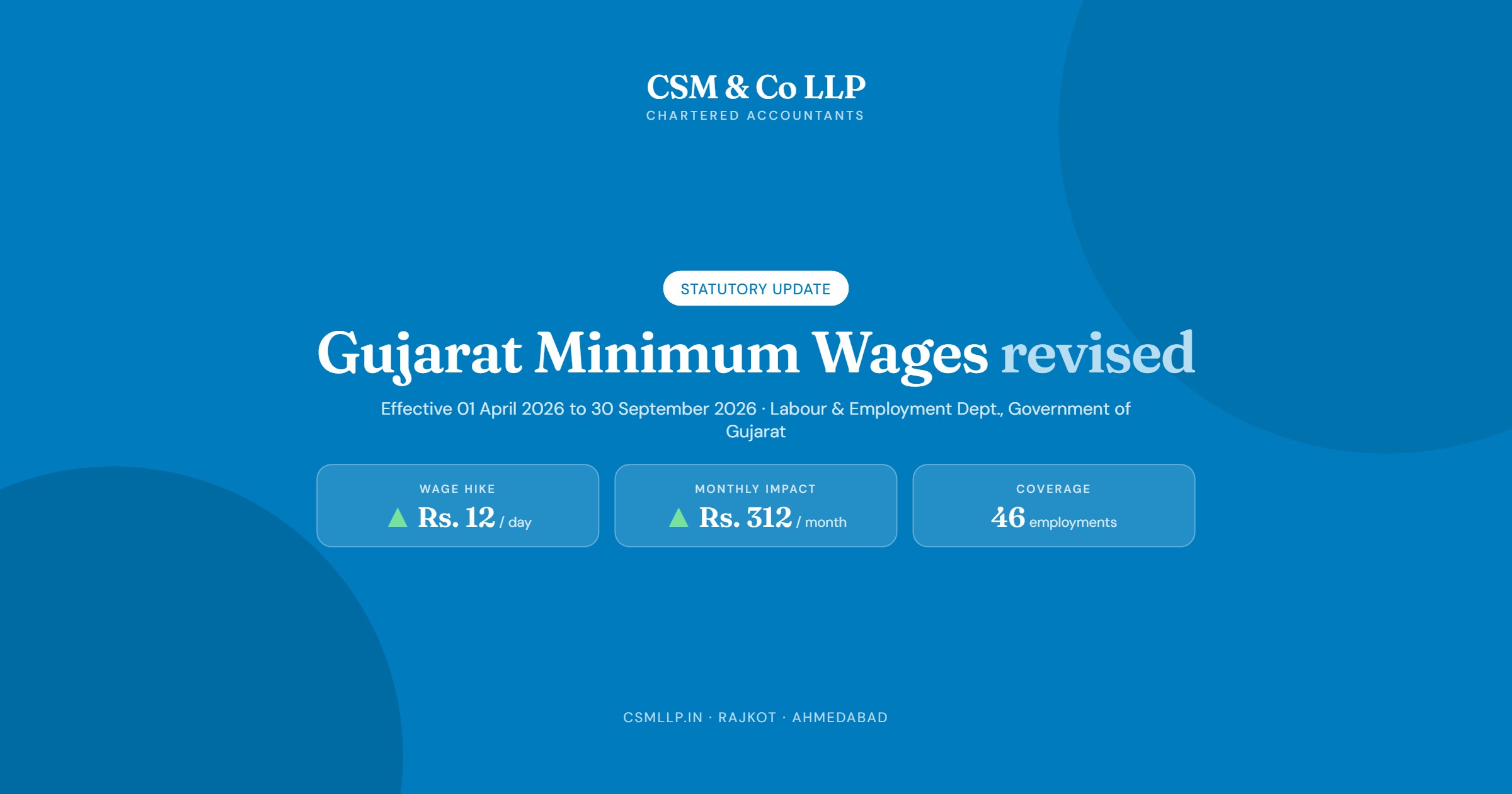
- Gujarat minimum wages hiked by Rs. 12 per day (approx. Rs. 312 per month).
- Effective 01 April 2026 to 30 September 2026.
- Applies to 46 scheduled employments, factories, ship-breaking work and sweeping & cleaning work.
- Employers must revise payroll, wage registers and notice boards from the April 2026 wage cycle.
The Labour & Employment Department, Government of Gujarat has notified a revision in minimum wages applicable across the State. The revised rates are effective for the six-month cycle 01 April 2026 to 30 September 2026.
Every employer in Gujarat covered under the Minimum Wages Act, 1948 must reflect these revised rates in wages payable from the April 2026 wage cycle onwards. Non-compliance carries penal, financial and reputational risk — and is a common finding during labour inspections and internal audits.
Notification at a glance
- Effective period: 01 April 2026 to 30 September 2026
- Notification reference: ક્રમાંક: પ.લ.મ.૬/ટ.૩/૨૦૨૬/૧૪૨ થી ૧૬૪, dated 01-04-2026
- Issued by: Labour & Employment Department, Government of Gujarat
- Wage revision: +Rs. 12 per day / +Rs. 312 per month
- Coverage: 46 scheduled employments, factories & ship-breaking work, and sweeping & cleaning work
Revised daily minimum wage rates (in Rupees)
The “Per day” figure is what an employer must pay a worker per working day. It is the sum of Basic and V.D.A.
Scheduled employment / Factory / Ship-breaking work
| Category | Zone | Basic | V.D.A. | Per day | Per month |
|---|---|---|---|---|---|
| Skilled | Zone I | 474.00 | 60.50 | 534.50 | 13,897 |
| Semi-skilled | Zone I | 462.00 | 60.50 | 522.50 | 13,585 |
| Unskilled | Zone I | 452.00 | 60.50 | 512.50 | 13,325 |
| Skilled | Zone II | 462.00 | 60.50 | 522.50 | 13,585 |
| Semi-skilled | Zone II | 452.00 | 60.50 | 512.50 | 13,325 |
| Unskilled | Zone II | 441.00 | 60.50 | 501.50 | 13,039 |
Sweeping & cleaning work
| Zone equivalent | Basic | V.D.A. | Per day | Per month |
|---|---|---|---|---|
| Zone I equivalent | 452.00 | 60.50 | 512.50 | 13,325 |
| Zone II equivalent | 441.00 | 60.50 | 501.50 | 13,039 |
Zone classification
- Zone I: All Municipal Corporations and Municipalities in Gujarat.
- Zone II: All other areas in Gujarat not covered under Zone I.
Worker category definitions
- Unskilled: Simple duties requiring the operation of simple tools or machines and little or no independent judgement.
- Semi-skilled: Work of a defined routine nature; the requirement is judgement of a limited scope, not skill.
- Skilled: Working efficiently while exercising considerable independent judgement, with thorough knowledge of the trade.
- Highly skilled: Working efficiently and supervising the work of skilled workers.
Understanding V.D.A. (Variable Dearness Allowance)
V.D.A., also called the Special Allowance or Dearness Allowance, is a component that is revised periodically based on movement in the Consumer Price Index (CPI). For this cycle, V.D.A. is Rs. 60.50 per day uniformly across all categories and zones.
It must be paid over and above the basic minimum wage, or, at the employer’s option, merged into the basic — provided the total payable to the worker is not less than the notified minimum “Per day” rate.
Employer compliance checklist
- Update payroll master. Revise the daily and monthly rates against each worker in the payroll system with effect from 01 April 2026.
- Reclassify workers correctly. Confirm each worker is tagged to the correct Zone (I or II) and skill category. Misclassification is one of the most common findings in labour inspections.
- Wage register & wage slip. Ensure Form XVII (wage register) and Form XIX (wage slip) reflect the revised Basic and V.D.A. components separately.
- Statutory deductions. Review the downstream impact on ESIC, EPF, Professional Tax and Labour Welfare Fund contributions where these are computed on gross wages.
- Contract labour & outsourced staff. Cross-check that contractors and manpower agencies engaged by the establishment are also paying the revised minimum. The principal employer’s liability under the Contract Labour (Regulation & Abolition) Act, 1970 continues.
- Notice board. Update the notice of rates of wages displayed at the workplace, as required under Section 18 of the Act.
- Retain the notification. Keep a copy of the Gujarat notification on file for inspection.
Penalty for non-compliance
Under the Minimum Wages Act, 1948 (read with the Code on Wages, 2019, once fully notified), paying less than the notified minimum wage is a punishable offence. The Authority may also direct the employer to pay the shortfall to the workers along with compensation, which may extend to ten times the amount of such shortfall. In practice, the financial exposure from back-wages, compensation and interest can far exceed the statutory fine — which is why periodic internal audits of payroll compliance are worth the investment.
Frequently asked questions
Q1. Is the “Per day” rate gross or net?
The “Per day” rate is the gross statutory minimum payable to the worker for a working day. Statutory deductions such as EPF, ESIC and PT continue to apply on top of this, per the respective statutes.
Q2. Is V.D.A. mandatory over and above Basic?
Yes. V.D.A. must be paid in addition to the Basic wage, or merged into the Basic, so long as the total is not less than the notified “Per day” rate. Paying only the Basic component (without V.D.A.) is non-compliance.
Q3. Does this notification apply to contract workers?
Yes. Contract workers engaged through a manpower vendor or licensed contractor are entitled to the same minimum wage. The principal employer remains liable if the contractor defaults.
Q4. Is a worker in Vadodara Municipal Corporation limits in Zone I or Zone II?
Vadodara Municipal Corporation is a Municipal Corporation, so it falls under Zone I. Areas outside the Corporation limits generally fall under Zone II — refer to the notification for the specific area boundaries.
Q5. What if the worker is paid a monthly salary that already exceeds the minimum monthly figure?
Compliance is measured on the “Per day” rate. If the monthly salary divided by the number of working days in the wage period is at least equal to the notified “Per day” rate, the employer is compliant. Ensure this holds even in months with fewer working days.
Q6. Does the revision apply to apprentices and trainees?
Apprentices covered under the Apprentices Act, 1961 are governed by that Act’s stipend rates. Trainees not covered by the Apprentices Act are treated as workers and are entitled to the minimum wage.
How CSM & Co LLP can help
At CSM & Co LLP, Chartered Accountants, we work with employers across Gujarat on Internal Audit, Tax and MIS Dashboards. As part of these engagements, we regularly cover payroll and labour law compliance areas including:
- Reviewing the payroll register for correct application of the revised Gujarat minimum wages
- Auditing contractor and manpower vendor wage compliance for the current cycle
- Assessing exposure under ESIC, EPF, Professional Tax and Labour Welfare Fund
- Building a periodic MIS dashboard for tracking labour law compliance and payroll KPIs
Please reach out to our team and we will be happy to assist.
Disclaimer
The rates and provisions summarised above are based on the notification issued by the Labour & Employment Department, Government of Gujarat. While every effort has been made to ensure accuracy, employers are advised to refer to the official Gujarat Government notification (ક્રમાંક: પ.લ.મ.૬/ટ.૩/૨૦૨૬/૧૪૨ થી ૧૬૪, dated 01-04-2026) for the authoritative text before acting. This post is for general information and does not constitute legal or professional advice.